
 ARCHITECT & VISUAL ARTIST
SEBASTIAN
TOWERS
TRANSMUTATION
BIOGRAPHY
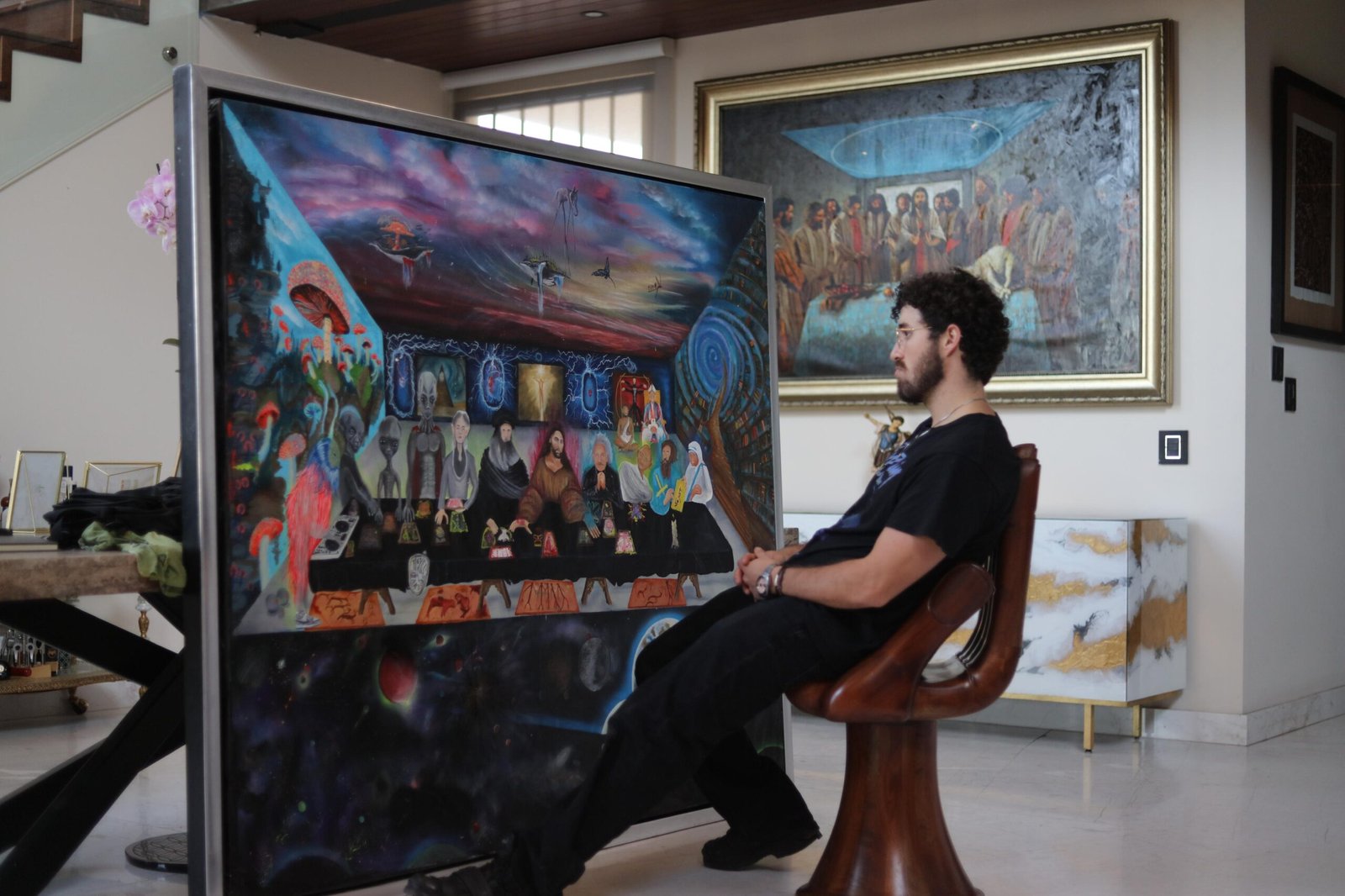
Sebastián Torres is an architect and visual artist. He was born in Pachuca, Hidalgo, and currently lives and works in Mexico City. His practice unfolds at the intersection of painting, energy, perception, and space, understanding art as a lived experience and a means of sensitive connection capable of generating emotional bonds and collective reflection.
He has exhibited his work in institutional venues such as the Museum of the Palace of Autonomy of the UNAM and the World Football Museum of the Pachuca Group, as well as in individual and collective exhibitions in collaboration with the Ministry of Culture of the State of Hidalgo and various independent spaces in Mexico City.
He has given lectures on art and architecture at the Autonomous University of the State of Hidalgo.
His work has engaged with diverse contexts and audiences, from the creation of the official portrait of the former governor of the State of Hidalgo, Omar Fayad Meneses, to the creation of pieces for the American actor and artist Drake Bell.
This breadth of registers reflects a flexible and transversal practice, capable of adapting to different scales and languages without losing conceptual coherence.
STATEMENT
Sebastián Torres's work approaches painting as a field of energy and perception rather than as a representational image. His practice investigates the relationship between consciousness, time, spirituality, and the human condition from a symbolic and contemporary perspective, where the pictorial is understood as a space of transition and transformation.
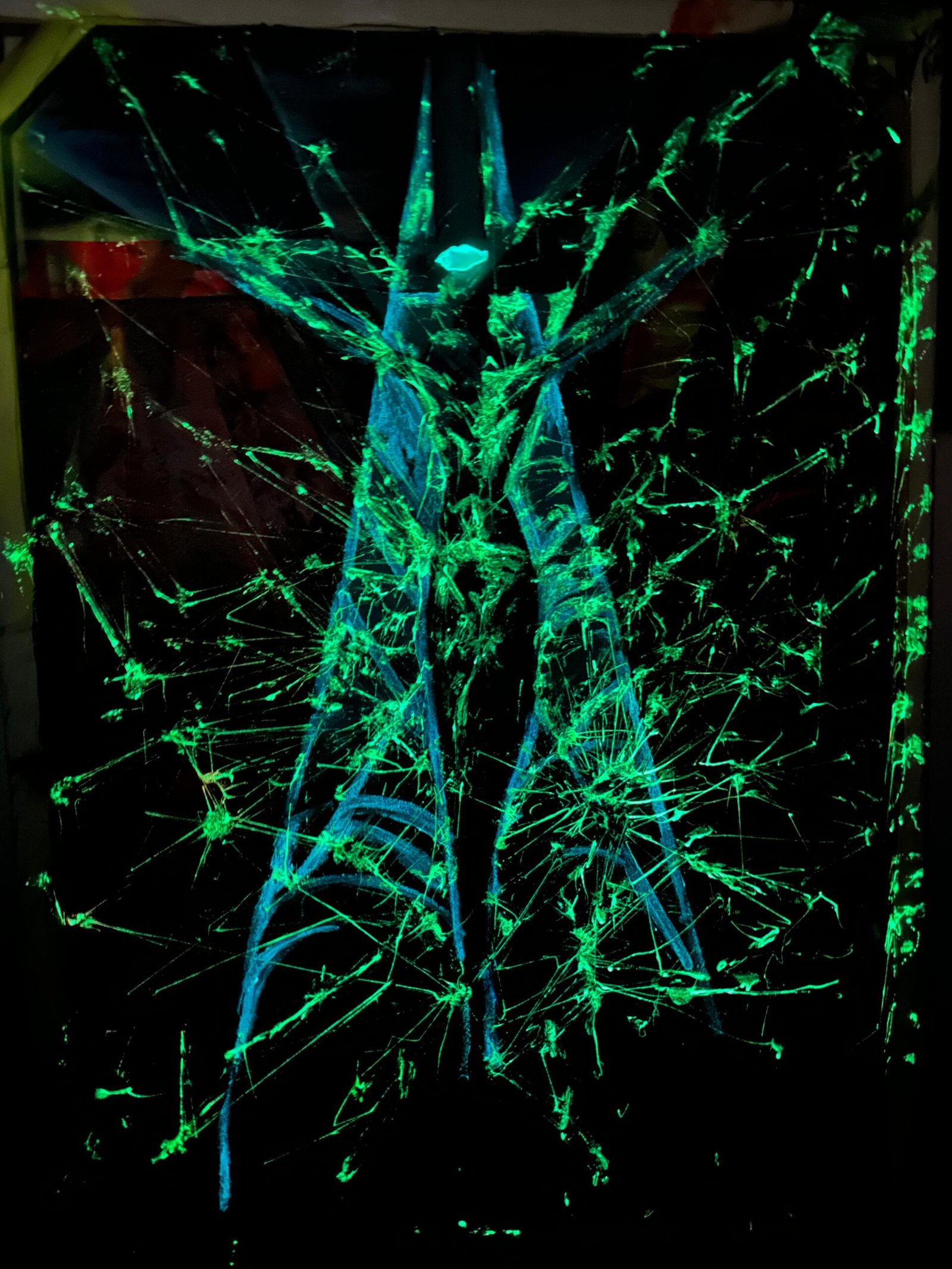
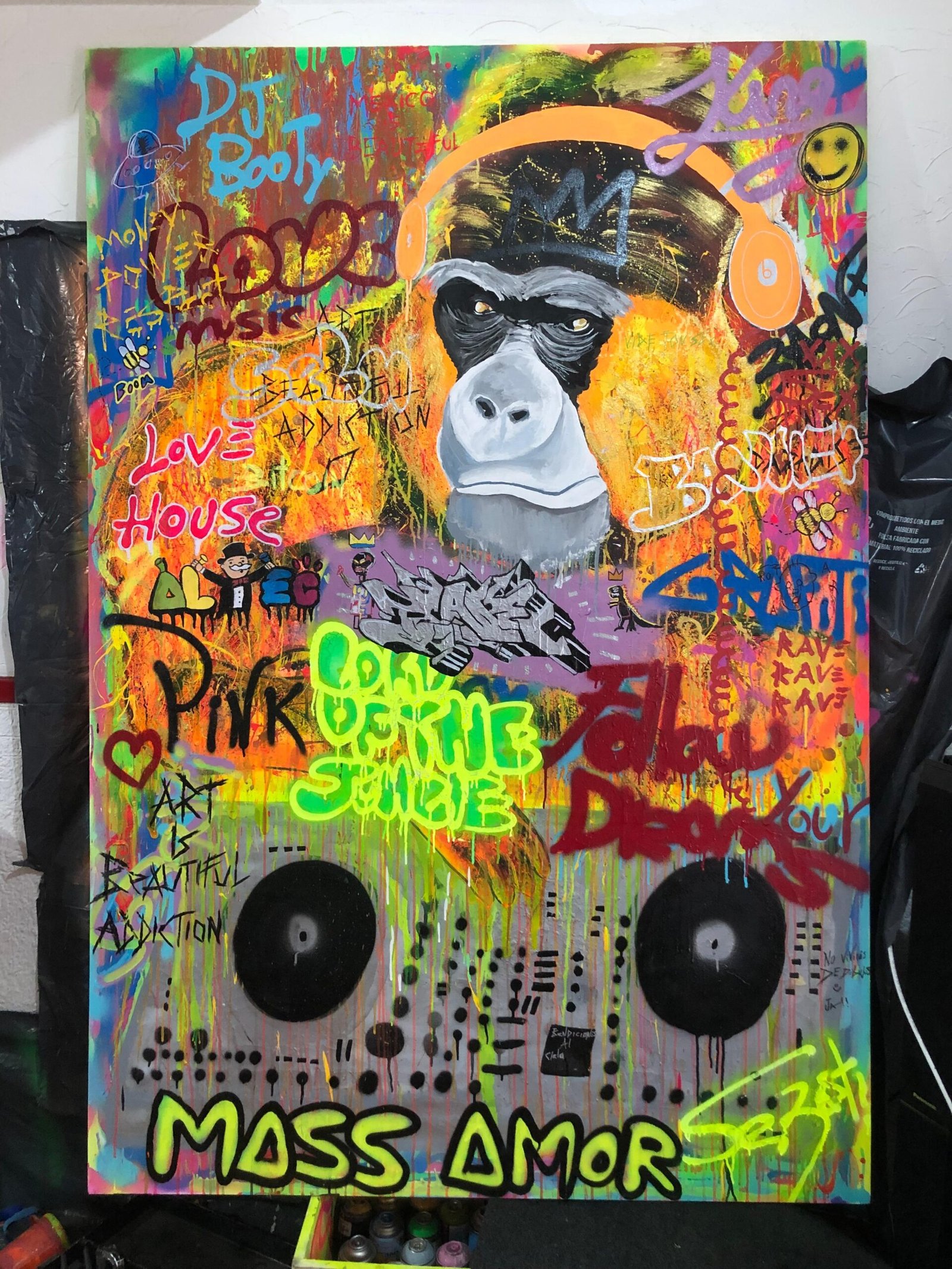
The process functions as a constant laboratory for technical experimentation. He works with oil, acrylic, airbrushing, and mixed media, centrally incorporating the use of the pendulum as a gestural tool.
This device allows him to record movement, energy, and controlled chance, becoming a distinctive feature of his visual language and a method for activating the work from bodily and temporal experience.
The series Transmutation (2025) delves into the processes of change that matter, consciousness, and space undergo. Far from proposing a linear narrative or a promise of enlightenment, the work is articulated as a journey through different states—origin, wonder, internalization, equilibrium, collapse, dimension, and coexistence—where the human, the abstract, the energetic, and the cosmic intertwine.
In this context, art is conceived as a space of containment and questioning. Change is neither imposed nor idealized, but rather revealed as a natural, continuous, and, in many cases, silent process that manifests itself in the very experience of painting.
CONCEPTUAL FRAMEWORK
CONCEPTUAL GLOSSARY
The concept of truth as unveiling. Truth appears in a partial, situated, and never definitive way.
Negation of the hierarchy between front and back. Every side of the work is a plane of meaning.
A space where there is no separation between matter, spirit, image, and experience.
Construction of the work from material and perceptual sediments that are revealed over time.
Process by which something latent becomes visible without being exhausted in its appearance.
A procedural presence, living and active, not monumental or fixed.
The work understood as an event that occurs in the experience of the spectator.
Activatable matter that allows the revelation of latent layers under black light.
Productive resistance that prevents a closed reading and keeps the work in tension.
An image that does not illustrate or replace the world, but rather activates it perceptually.
Condition in which everything happens on the same ontological plane, without external transcendence.
Visual structure without a center or single resolution, open to multiple paths.
Conditions of appearance that modify perception without materially altering the work.
Work not closed, always available for new activations.
Visible accumulation of decisions, journeys, and material transformations.
Truth understood as something that happens in the work and not as a message.
Gradual unfolding of meaning that is never offered immediately or completely.
A temporal dimension that demands slowing down and sustained attention.
Transition from one state to another without definitive fixation. Ethics of becoming.
Internal drive that keeps the work in constant transformation.
AVAILABLE WORKS
WORK RECORD

FURTHER READING
- The origin of the artwork.
Martin Heidegger. In Forest Paths. Madrid: Alianza.
(Foundational text of the concept of “putting truth into practice” and of truth as aletheia.) - Phenomenology of perception.
Maurice Merleau-Ponty. Paris: Gallimard.
(Key to understanding the work as a bodily and perceptual experience.) - The open work.
Umberto Eco. Milan: Bompiani.
(The work as an open-ended structure, activated by the viewer.) - The relevance of beauty today.
Hans-Georg Gadamer. Barcelona: Paidós.
(The aesthetic experience as an event and a game of appearance.) - To see and not to see.
John Berger. London: Penguin Books.
(The gaze as a cultural construct and a conscious act.) - The time-image.
Gilles Deleuze. Paris: Minuit.
(Think about the image from the perspective of time, becoming, and mutation.) - The space of thought.
Gianni Vattimo. Madrid: Chair.
(Art, truth, and the weakening of strong structures.) - Against the method.
Paul Feyerabend. Mexico City: Sexto Piso.
(Critique of closed systems and defense of the plurality of modes of knowledge.) - Art and visual perception.
Rudolf Arnheim. Berkeley: University of California Press.
(Perceptual structures, form, tension, and visual organization.)